» Main Index

» Search This Site
» Submit Update
» Contact Us
|
|

|
Home > Essex >
Great Hallingbury > Hop Poles
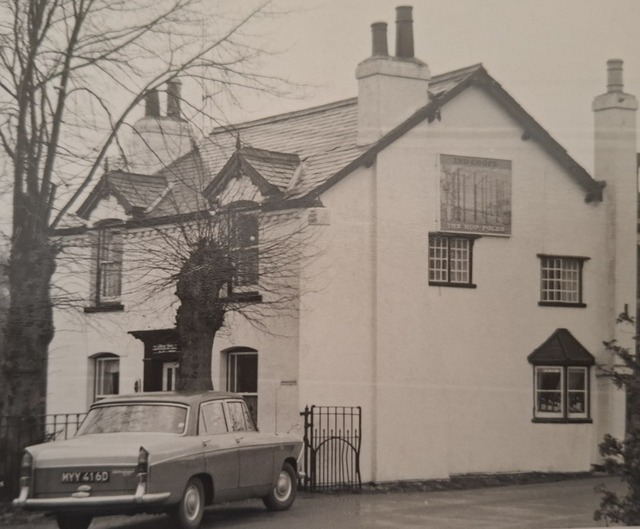
Hop Poles
 |
|
Date of
photo: 1967 |
Picture
source: John Cutting |
|
|
|
|
|
|
The Hop Poles was situated at Bedlars
Green. This pub closed in 2014. |
|
|
|
|
|
|
Local newspaper review by John Cutting, 1967 |
Hop fields were at one time a familiar sight
in the Essex countryside. The plant was introduced into the county during
the 16th century and in the reign of the first Elizabeth the trade of making
hop poles led to extensive cutting down of the trees in Hatfield Forest. Two
hundred years later the cultivation of hops in this part of the country
started to decline and finally died out around 1890.
There are in East Anglia a number of inn signs commemorating this attractive
plant which has always been associated with the brewing of beer.
It is probable, however, that the sign on the wall of the inn at Great
Hallingbury represents the arms of the Houblon family who lived, for many
years, at Hallingbury Place. (The French name for a hop pole is houblon).
One famous member, Sir John Houblon, is remembered today as the first
Governor of the Bank of England.
Great Hallingbury which, today in the shape of a five-pointed star, tends to
engulf Hatfield Forest was described in Domesday Book as a place with
“woodland for 600 swine and 25 acres of meadow.”
Hatfield Forest, famous for its hornbeams, is now the property of the
National Trust but until 1924 it was privately owned.
The Hop Poles was then the blacksmith’s shop attached to the estate. The
resident smith was, apparently, offered the freehold of the property for a
modest sum but he was unable to accept and the building was bought by
Benskin’s Brewery who set up the inn.
There is evidence, however, that beer was brewed at the smithy many years
before. The blacksmith’s shop was invariably the meeting place where
villagers would congregate and exchange news and gossip.
It was natural, therefore, for an enterprising wife to offer beer to the
assembled company and many an old inn started life as a smithy.
Much of the house has been “restored” at various times but there is enough
of the original fabric left to show that the inn is an 18th century
timber-framed building. Adjacent to the Hop Poles the original forge is
still in position.
The present landlord, William Blake, has made various changes to the
interior of the inn during the past twelve months. The public bar has been
enlarged and William hopes that the brewery will agree to extend the saloon
by incorporating one of the ground floor living rooms. William is a keen
gardener and has plans to cultivate the seven acres of land that belong to
the inn. So far, however, he has found the soil unrewarding.
Among many attractive paintings in the saloon is a picture showing, in all
its glory, the lovely garden attached to the 16th century cottage near
Moreton which was William and Eleanor Blake’s previous home.
The artist is Ann Dallas who is Eleanor’s sister. There is a remarkable
bench made out of a billiards table which was once at Hallingbury Place
while the table in the bar is made from a couple of shove-halfpenny boards.
In the public bar there is a well placed darts board and, over the counter,
are the antlers of a stag which was found dead in the garden at the back of
the inn when William first took over.
There is always a welcome at the Hop Poles but a stranger is advised not to
be misled by an invitation to have a drink, couched in refined accents,
immediately he enters the inn. The voice belongs to Jeeves, a mynah bird,
who is a permanent resident in the bar.
On Bedlar's Green the old village pump still stands but an adjoining power
station which once supplied water to all the residents has been pulled down.
From the Green there is a public foot-path which leads to the middle of
Hatfield Forest. Apparently however, a large sign bearing the words “Private
Road” dissuades many travellers from using this right of way.
Although the number of farming employers continues to grow smaller the
population of Great Hallingbury has increased considerably over the past few
years as modern housing estates are built. There is no reason why the Hop
Poles should not attract a wide range of people from the surrounding area.
In the Forest wood cutters no longer strip the branches of the hornbeams to
provide mill-cogs and pulley blocks and many of the the famous old houses
have been demolished. Around Great Hallingbury however, in the light of the
moon on a winter’s evening it is still possible to visualise the scene so
well expressed by the poetess who wrote:
“The stately homes of England,
How beautiful they stand!
Amidst their tall ancestral trees,
O’er all the pleasant land.” |
|
|
|
Brewers:
Ind Coope (East Anglia) Ltd |
|
|
|
Do you have any anecdotes, historical information, updates or photos of this pub? Become a contributor by submitting them here.
You can add your email contact details along with other ex-customers and landlords of this pub here. |
|
|