» Main Index

» Search This Site
» Submit Update
» Contact Us
|
|

|
Home > Oxfordshire >
Henley > Imperial Hotel
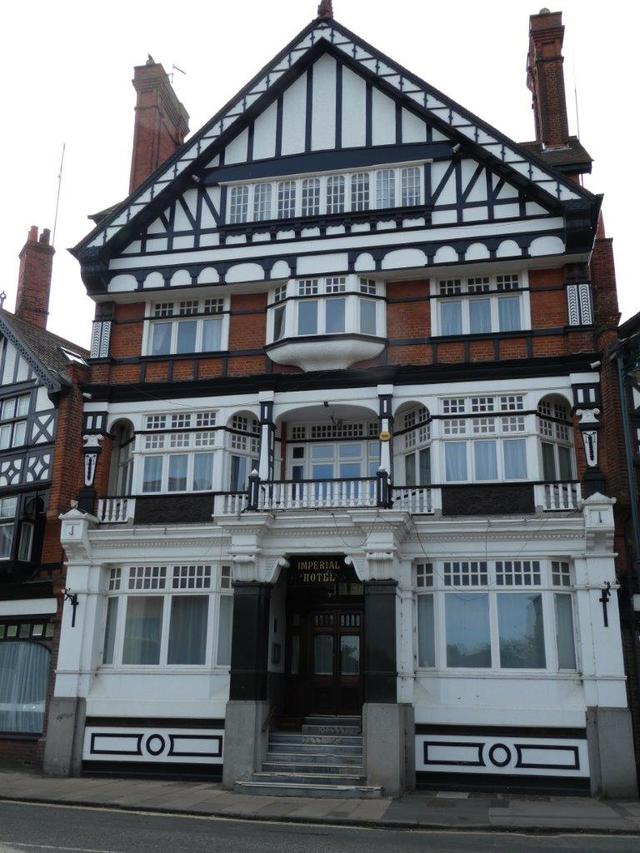
Imperial Hotel
 |
|
Date of photo: 2016 |
Picture source:
Michael Croxford |
|
|
|
|
The Imperial Hotel was situated on
Station Road.
This
grade-II listed
pub closed in 2006. |
|
|
|
|
|
|
Listed
building details: |
MATERIALS
Red brick with decorative timber framing; clay tile roof.
PLAN
The Imperial Hotel forms the centrepiece to a curving range of nine
buildings, comprising Nos. 15-41 (odd) Station Road. The hotel building is
of double width, and has a central hallway and stair flanked
by the former bar and lounge, with a large function room behind and bedrooms
on the upper floors. The flanking ranges have shops on their ground floor
and domestic accommodation above.
EXTERIOR
The hotel and its two flanking ranges form a picturesquely rambling
composition on a prominent corner site. The style is a richly ornamented
Domestic Revival in the 'Old English' manner of Richard
Norman Shaw, with much 'Jacobethan' ornament and decorative half-timbering
contrasting with the bright red brick of the main structure. The hotel
itself is taller and wider than its companion
buildings, rising to four storeys beneath a broad triangular gable with
decorative barge-boards and timber framing, crowned by a terracotta dragon
finial; the gable is flanked by two massive ridged
brick chimney stacks, and its upper section is jettied out over an oriel on
the floor below . The first floor has two polygonal bays faced with
terracotta bas-relief panels depicting grotesque figures;
between these is a balcony framed by arches supported on shaped balusters.
The ground floor also has polygonal bays flanking the central entrance. The
latter is deeply recessed within a porch framed
by massive scroll-topped piers clad in grey granite and larvikite, the
right-hand pier bearing the architect's name. The porch recess has a grey
marble dado, a guilloche frieze and a wrought-iron
scrollwork panel bearing the name of the hotel. A flight of steps leads up
to the main doors, which are of oak with bevelled glass panels and raised
and fluted pilasters to the outer sections. There is a
smaller hatch to the right, presumably for off sales.
The flanking ranges each comprise five units, with taller gabled bays of
three storeys alternating with lower two-and-a-half-storey elements. As with
the central block, there is much decorative
timberwork and an array of tall ridged stacks. The upper floors of the
gabled bays are jettied out on curved sandstone brackets over projecting
oriels. The far left-hand unit, No. 15, returns to Queen
Street and has a corner cupola topped with a weathervane. The ground-floor
shop-fronts mostly survive, though some have been altered; they have curved
transoms with small square lights above
and panelled stall-risers below. The doors have shaped glazed openings and
scrollwork decoration,and the flanking piers are faced in purple glazed
brick. The rear elevations of both the hotel and the
outer ranges are of plain red brick without ornament.
INTERIORS
The hotel entrance opens into a lobby area with a mosaic floor and a
guilloche frieze, from which doors with heavily moulded architraves open
left and right into the bar and what was presumably
once the lounge (both areas much altered, with some walls knocked through).
Steps and an archway lead through to the principal stair, of elaborately
carved mahogany with twisted balusters and huge tapering newels crowned by
acanthus-leaf finials. Behind is a large room running the full width of the
building, once presumably a dining room or ballroom, with pilastered walls
and a deeply coved
ceiling; an archway to the rear must once have opened into a conservatory,
now demolished. The upper floor interiors are utilitarian and extensively
altered, as are those of the outer ranges, which
renders these parts of the interior not of special interest.
History
The Imperial Hotel with its associated ranges was built c.1897 to the
designs of the London architect William Theobalds. The site lay immediately
opposite the original entrance to Henley railway station,
whose opening in 1857 triggered the development of this area of the town;
the station was rebuilt 50 metres further south in 1985. The hotel is one of
Henley's principal landmarks, and its scale and
architectural exuberance reflect the town's popularity as a riverside resort
in the late C19 and early C20. |
|
|
|
Do you have any anecdotes, historical information, updates or photos of this pub? Become a contributor by submitting them here.
You can add your email contact details along with other ex-customers and landlords of this pub here. |
|
|