|
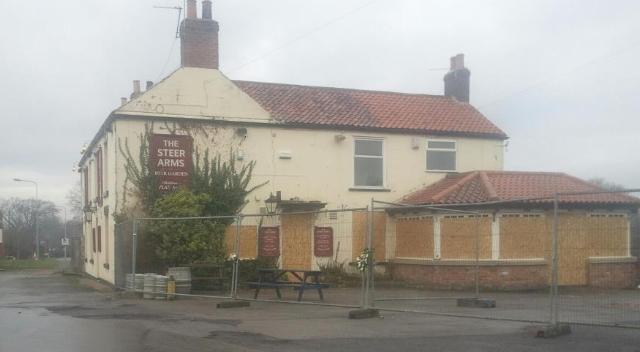
The Steer arms was said to be built in 1714
but map evidence suggests it is of mid 19th century date. The public house
continued in use after being altered 'once or twice' until closure in 2014.
The Steer Arms and its surviving outbuildings were demolished to ground
level in 2018 and its footings, foundations, bases of walls and cellar
survive as sub-surface remains.
The datestone of the building was removed during renovation but a previous
tenant remembered it showing 1714.
The hotel was used at least once as a court where inquests were held
A detailed record of works done on the steers arm c1880
The Steer Arms was built on the site of an earlier 'housestead' shown on the
1803 Isle of Axholme enclosure map and the 1842 Belton tithe
map. The Steer Arms had been constructed by 1847 but was not shown on either
of the earlier maps. While the Steer Arms formerly contained a '1714'
datestone, the provenance of the latter is unknown. It is possible that this
feature was originally set in one of the buildings of the ‘housestead’.
The Steer Arms was built over the site of one of the housestead buildings,
although the larger of these remained extant until the mid-20th century.
Several outbuildings stood around the pub yard, while the land to the east
was used as a paddock and the land to the south became a car park and beer
garden. A stone-lined well was present within the footprint of the pub. It
is not clear if this feature was constructed for the public house or the
earlier housestead. The well
appears to survive in relatively good condition.
The Steer Arms and its surviving outbuildings were demolished to ground
level in 2018 and its footings, foundations, bases of walls and cellar
survive as sub-surface remains.
The Steer Arms public house had been constructed by 1847, when it was used
as the site of an auction for several properties that had been seized
following the bankruptcy of the vicar of Belton (Anon. 1847, 3353). The pub
appears to have been named after the Steer family, who had intermarried with
the Popplewells (Stonehouse 1839, 342). Subsequent Ordnance Survey maps
showed that the pub had been built over the site of the smaller of the two
buildings that had been shown on the 1803 and 1842 maps. It is not clear if
this was the early 19th-century house or its outbuilding. The stone-lined
well was also located within the
footprint of the public house. It is not known if the well was sunk during
the construction of the Steer Arms or had formed part of the earlier
housestead
that occupied this area. A greenhouse was shown on the south elevation of
the pub on the 1886 map.
The largest of the two earlier buildings remained extant to the east of the
public house, while an extension had been added to its south-west corner. A
series of outbuildings had been constructed along the northern site
boundary, the largest of which was a rectangular building that was separated
from the Steer Arms by a passage from the street into the yard to the rear
of the pub. A wall or fence demarcated the west side of the pub yard, while
a small outbuilding had been constructed on its south side. To the south of
the public house, a small part of the field had been fenced off to create a
small enclosure, while a broad track ran north-east from the road, across
the field towards the centre of the Site. This appears to have provided
access to the former orchard without having to cross the pub yard.
The development of the pub, outbuildings and land is traced via later map
editions and aerial photographs. The site of the demolished pub was visited
in 2019 and the remains described.
Archaeological evaluation comprising the excavation of trial trenches was
undertaken in 2019 to inform a planning application for residential
development on the site of the former Steer Arms. Made ground formed by the
demolition of the Steer’s Arms public house was present in the northwest of
the development site. |