» Main Index

» Search This Site
» Submit Update
» Contact Us
|
|

|
Home >
Bedfordshire > Toddington > Sow & Pigs
Sow & Pigs
 |
|
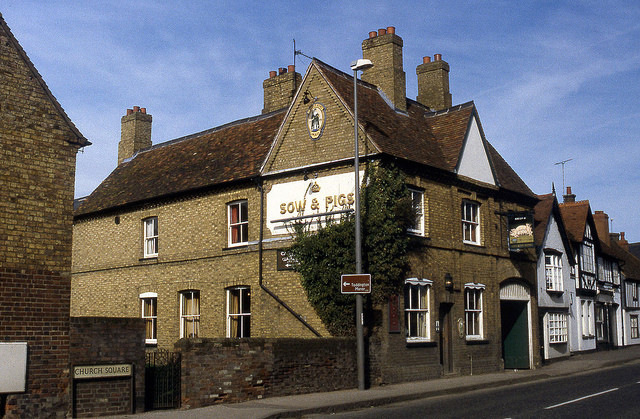
Picture source: Allan
Friswell |
|
|
|
|
The Sow & Pigs was situated at 19 Church Square.
It was built in the mid-19th century on the site of an earlier, 16th
century, pub. |
|
|
A truly great, off the wall, eccentric pub run
by the inimitable, unforgettable Roger and his long-suffering wife Sue.
Roger would arbitrarily ban anyone for anything. But if you turned up next
night he’d welcome you back affably as if nothing had happened. No food,
just sarnies sometimes. Greene King ales of the very best presentation. It
remains the only pub I’ve ever entered, mid-afternoon, into a bar empty of
all but one customer, sitting reading his paper with a brown paper bag with
holes on over his head. It stayed in place for the length of my two pints...
It was also memorable for having Roger, in his coffin, taken out through a
downstairs window from the back bar post-wake.
So very very sad to see it closed. Sue, I suspect, wasn’t up to running it
alone. But that it wasn’t snapped up by another manager amazes me. It was
one of, I think, only half a dozen pubs countrywide to have appeared in the
GBG from the first edition till it (the pub) closed. |
|
Allan Friswell (November 2014) |
|
|
Before Roger took over the Sow and Pigs
was run by another eccentric. I first went in about 1975 when living in
Dunstable. I walked in to a pub that looked as if it had last been decorated
before the war, possibly WWI. There was one person there plu the landlord. I
asked for a pint of GK bitter. The landlord turned round without uttering a
word and disappeared. Some minutes later he appeared with a superb pint.
This was at a time when virtually the only beer available in the area was
Whitbread Trophy of equivalent swill. (although Youngs was available in the
Vauxhall Motors Recreation Club. Two or three pints later I asked why he did
not use the hand pumps ‘It spoils the beer’. Later he got in Abbot Ale too
but refused to serve it in thundery weather.
There was a small but diverse set of regulars ranging from the auctioneer to
a character with mental issues, harmless but possibly the person with the
paper bag over his head. I well remember one evening when that character
came in. Someone asked ‘Where’ve you been Jed (or some similar name). ‘I
been lurking’ ‘Where you been lurking’ ‘In the churchyard’ The churchyard
was opposite and like many old church yards the level is a couple of metres
above street level. ‘Jed’ liked to lurk there and jump out at unsuspecting
passersby. Innocent fun - by standards at that time.
When Roger came in he painted the place in a warm colour (probably fire
brick) and introduced food even if only sarnies and horror of horrors
brought the pumps back into use. Revolutionary stuff that brought the
punters in. The Sow and Pigs was a welcome contrast to the fancy fairy light
festooned pubs on the green.
Given its position opposite the church it must have an old history despite
its 19th C brick exterior.
A sad loss. It’s 40 years since I left the district and I have lived
overseas for most of that time. I often fondly recall a great pub. I had
been thinking of paying a visit next time I’m back. |
|
Neil Thomson (February 2018) |
|
|
|
In 1978 I was a graduate Commercial
Trainee with George Wimpey Construction Ltd, then a multi national
contracting group, and I was posted to their Toddington Road, Sundon, Luton
office for six months. Every Friday lunchtime the buying department would
head for a pub in Toddington for an extended lunch. Mostly outside of the
summer we would go to the Sow and Pigs and get locked in until five or so!
The landlord and his wife would serve us steak sandwiches on the house. We
would then stagger back to the office just as it was closing. Other than
that in the summer it would be the Bedford Arms, also sadly gone I believe?
At one time it was said that Toddington had the highest density of pubs per
head of population than any village in England. Happy days |
|
Garry Cuddon (April 2019) |
|
|
|
|
|
|
From Bedfordshire Heritage: |
Joseph Blundell in Toddington: Its Annals and
People states that the Sow and Pigs had been in existence since the 17th
century. The original inn was demolished in the mid-19th century and
replaced with the existing Victorian property. In an article in The
Bedfordshire Magazine Volume II of 1949 Page Woodcock stated: "My companion
on this fact-finding tour assured me that the inn had obtained its sign from
the frieze of sows and pigs on the old Gothic church opposite. Soberly
viewing the greatly weathered cornice chiselled in Totternhoe stone, I was
startled to see that one "sow" possessed what looked like the hind legs of a
kangaroo. Closer inspection revealed even more unnatural members of the pig
family until I became convinced that the bucolic masons who carved the
animals had spent a considerable time in the inn itself". Today a modern
carving of a sow and her piglets adorns the frieze.
Page Woodcock went on: "The present Sow and Pigs was built about 1850, after
its predecessor's demolition. Blundell says that the old house was three
hundred years old; certainly it was there in 1681 when "16 butchers alone
had stalls on the market". This 19th century building was, itself, altered
in 1908.
In 1803 widow Mary Dix leased the Sow and Pigs to Richard Gibbs, cow dealer,
for seven years at a rent of £19 per annum. In 1835 Biggleswade brewers
Frederick Hogg and William Lindsell (their company later became Wells and
Company) were admitted to the Sow and Pigs, which was a copyhold property,
at the manor court of the Manor of Toddington.
Licensed premises in the centre of Toddington figure quite frequently in
Quarter Sessions records for the mid-19th century. In 1854 licensee William
Shaw gave evidence against Richard Johnson. Johnson was a stranger to him,
who came and lodged at the Sow and Pigs on 31st March and remained there
until 3rd April when he left. On 31st March there had been a pair of
breeches tied up in a handkerchief in a cupboard in the room where the
prisoner slept. A pair of stockings was in the drawers in the same room.
After the prisoner had left Shaw missed the breeches, handkerchief and
stockings. Johnson had been apprehended with the clothing at the Marquis of
Chandos public house in Newport Pagnell [Buckinghamshire]. He later told the
arresting officer that he was sorry for the crime and hoped the prosecutor
would be as lenient as he could as he could not think what induced him to
steal them. Johnson, who was 45 and from Holbeach [Lincolnshire] was given
three months' hard labour.
Two years later Shaw's wife, Sarah, have evidence against George Pardo
[QSR1856/1/5/9] who had come into the tap room and asked her and her servant
if she wanted any needles. Both women said they did not and the prisoner
asked for two penny-worth of rum. This was served to him and he paid the
servant with a half -crown piece and he was given two shillings and a
four-penny bit in change. He asked her to change the four-penny bit for four
pennies worth of halfpennies, which she did. He then left the house. Sarah
then held the half-crown in her hand and detected it was a bad one. PC
Thorogood was passing the pub and she called him to the door and told him
she had received a bad half-crown from a tramp. She gave the half-crown to
the constable and he marked it with a cross. Pardo was 30 years old, from
Manchester [Lancashire] and was sentenced to six months' hard labour. He was
evidently a bad lot because earlier that year he had been given given a
three month sentence for "assaulting a female". In 1857 he would be given
another moth for assaulting a policeman and in 1860 a further fourteen days
for breaking windows.
William Shaw, as well as keeping the Sow and Pigs was also a plumber and
glazier. He was also busy giving evidence in legal cases. In 1858 he gave
evidence against Joseph Randall. On 12th March Sergeant Thorogood (he had
evidently been promoted) came to his house and asked if he had lost any
lead. The sergeant produced some lead which Shaw examined and found it to be
his. The value of the lead was 3s 6d. On 11th March he had seen Thomas Major
in his yard, who had evidently stolen the lead and Randall acted as the
fence, selling it on. Randall was 19 years old and got three months' hard
labour. Major, 59, got twenty one days.
Next year Sarah was back in court giving evidence. On 20th July there was a
holiday kept in Toddington and between 5 and 6 pm she went with her friend
to see what was going on. She had six shillings in her pocket and after she
had made some payments had eighteen pence or two shillings in silver in a
leather purse. She also had a plain sixpence without either a head or tail
upon it which had been in her possession for months. She had kept it so long
and never tried to pass it. Between 7 and 8 pm she missed her purse and its
contents. She told her friend but thought no more of it. On her return home
between 11 and 12, PC George came to her house and asked if she had lost any
money. She told him her pocket had been picked. George produced the
sixpence. William Watts had picked the pockets of a number of people and
received a sentence of four months' hard labour.
In 1866 William Shaw gave evidence against George Palmer in a rather more
serious trial [QSR1866/1/5/18]. Palmer was a labourer living at Toddington.
Between 10 pm and 11 pm on the night of Saturday 11th November Palmer came
to the Sow and Pigs with two others. They had some beer together and Palmer
appeared to be quite sober. Shaw was in the bar and Palmer in the Tap Rooms.
Shaw's son charged Palmer threepence for breaking a pot. Palmer put sixpence
on the table but said he would only pay twopence and began to use "the most
disgusting language" towards Shaw's son. Shaw overheard this and went to the
Tap Room and said he did not allow such language to be used towards his
children. Plamer, who had been sitting down, jumped up and put himself in a
fighting attitude then came across as if to strike Shaw. Shaw pushed the
prisoner back to protect himself. The prisoner came at him again with a
knife and struck at him with it. The knife hit a button on his waistcoat and
glanced from that to the hand of James Seagrave who was standing to one
side, cutting his knuckle. Another man, by the name of Alfred Baldwin, threw
Palmer down on a seat and the knife was wrenched from his hand. The blade
appeared pointed and four or five inches long. After this Palmer "was in a
great passion and kicked at Shaw". Shaw told him to be quiet and go home but
he refused and offered Shaw a shilling to have him taken home. Palmer
remained in the house about 45 minutes and then he left. There was no doubt
that if the blade of the knife had not been stopped by the button that it
would have entered Shaw's as Palmer struck out with great violence.
James Seagrave gave evidence that Palmer had said he would "break the bloody
nose" Shaw's son if he took threepence. He said Palmer had tucked up his
smock and put himself in a fighting attitude and that he struck over-handed
and with great violence. He heard the knife strike against something and it
glanced off and hit him on the knuckles, drawing blood. Alfred Baldwin, a
blacksmith working in Toddington and lodging at the Sow and Pigs gave
similar evidence adding that Shaw told Palmer to get out of the house after
Palmer abused his son. Baldwin did not know what became of the knife but he
saw it and it cut his thumb when he pushed Palmer down. He said Palmer had
been drinking beer but "he knew what he was about".
In his defence Palmer said: "Mr Shaw collared me and wanted to put me out of
the house but he could not do it. I went and stood against the fireplace. I
pulled out my knife to get a bit of baccy out of my pipe and they collared
me again and in trying to put my knife in my pocket I must have cut them."
Palmer was charged with assault with intent to kill and was probably lucky
to just be sentence to four months' hard labour. Eight years later he was
given ten days in the debtors' cells. At this time he is described as 32, 5
feet 2 inches tall, with brown hair, hazel eyes and a fresh complexion.
Shaw's final appearance as a witness was in 1866 when George Athews obtained
beer by false pretences. On the afternoon of 1st March Athews came into the
Tap Room and said he was going to work for his old master, Mr Janes, and
Janes had told him to come and have some beer and put it down to him. He
ordered a pint and then another. The prisoner had thirteen pence of beer
altogether. The next day Shaw let the prisoner have another two pints, the
value of eleven pence. The prisoner said the bill was to be set to Mr Janes.
The day after the prisoner had nine pence more of beer on the same account.
Needless to say Mr Janes would not pay and Athews received one month's hard
labour. He was 54 years old and had five previous convictions, the first
dating from 1832. His offences included: stealing boards; being idle and
disorderly; being a rogue and vagabond and stealing fowls.
In 1899 the Sow and Pigs was enfranchised by the Manor of Toddington,
becoming a freehold property. This was because Wells and Company had been
sold to Kentish businessman George Winch for the benefit of his son. The
name of the firm thus changed to Wells and Winch.
Under the terms of the Rating and Valuation Act 1925 every piece of land and
building in the country was assessed to determine the rates to be paid on
them. When the valuation was carried out for Toddington the Sow and Pigs was
owned by Wells and Winch brewery and the tenant was Henry Pope who had been
there since 1919. The annual rent was £35, slightly higher than the pre-War
rent of £33 per annum The premises consisted of:
Downstairs: Bar and tap room (both described as "miserable"); commercial
room ("fair"); reception room; kitchen; larder; and pantry.
Upstairs: Billiard room; six bedrooms, including four letting bedrooms;
bathroom and W.c.
Outside: Brick and tile stable; coach house; timber and thatch barn and
loft; brick and tile ware house; brick and corrugated iron stables; derelict
buildings.
Weekly trade was 1½ barrels (or 36 gallons) of beer per week and one gallon
of spirits per month. The valuer was not impressed by the Sow and Pigs,
describing it as a "poor looking house" and commenting that it was "not so
good as it was when Armstrong was here" i.e. 1907 to 1913.
In 1961 Wells and Winch was taken over by Suffolk brewer Greene King. The
Sow and Pigs was closed in 2011 and sold by Greene King. It is now [2016] a
dental practice. |
|
|
|
Do you have any anecdotes, historical information, updates or photos of this pub? Become a contributor by submitting them here.
You can add your email contact details along with other ex-customers and landlords of this pub here. |
|
|
|
Other Photos |
 |
|
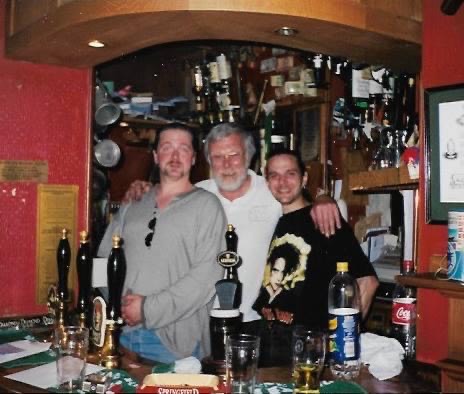
Date of photo: 1999 |
Picture source: Jason
Brooks |
|
|