» Main Index

» Search This Site
» Submit Update
» Contact Us
|
|

|
Home >
Bedfordshire > Clophill > Green Man
Green Man
 |
|
|
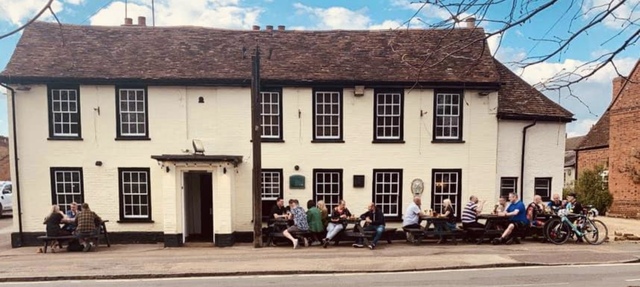
Picture source: Hania Franek |
|
|
|
|
The Green Man was situated on
the High Street. This
grade-II listed
pub closed in December 2022 following an arson attack that severely damaged
the building. |
|
|
|
|
|
|
From Bedfordshire Heritage: |
The main range of the building is aligned
roughly east-west and stands directly on the street frontage. Although
originally constructed as a timber framed building, the front elevation has
been rebuilt in brick and the infill of the timber framing in the east and
west elevations is now of brick nogging. This is obscured on the outside by
the painted render. To the east of the main range, which is of 7 bays, is a
narrow 2-storey extension that is neither as high nor as wide as the bay to
which it was added. This, too, is rendered and painted and covered with a
clay tiled roof. To the rear of the main range, behind the central chimney
stack, is a two-storey structure that was constructed at much the same time
as the main range forming a T-shaped building. A smaller 2-storey timber
framed structure was added at an early stage to the western end of the north
elevation. For the purposes of this report these sections are all part of
Building 1.
A series of extensions were subsequently added to the rear of the building.
To the north is a late 18th century, single storey brick-built structure
(Building 2). To the east of this and under a catslide roof is a
semi-subterranean cellar and store above (Building 3). An annexe was added
to the western end of Building 1 in 2002 providing a large rear entrance
lobby that incorporated late 20th century WCs (Building 4).
Exterior: Building1: The main range of Building 1 is of 7 bays and is
accessed by a door set within a modern porch in Bay 3. All the other bays
are lit by a 6 over 6 timber framed sash window on both floors, but that
above the porch has been bricked-up. Both the south and west elevations are
painted. The east elevation of this range has exposed timberwork with brick
infill. The bricks all measure 21 x 11 x 6cm (8¼ x 4⅝ x 2⅜") and are set in
an English Bond on the front elevation. A small section of exposed brickwork
to the rear is in header bond. The small extension to the east is rendered
and painted white and has two small windows in the front elevation and one
to the rear on the ground floor, and a single window at first floor level in
the east elevation.
Building 2: The brickwork fo Building 2 suggests that this single storey
structure has undergone considerable rebuilding. The main elevation to the
west has a set of French doors at the northern end, to the south of which is
red brickwork set in Flemish Bond. The walling to the north of the door can
be seen to have been rebuilt, as has the north elevation where the gault
bricks contrast sharply with the red brickwork below. The scar line of an
earlier roof and a blocked window are evidence within the gault brickwork.
Building 2, like Building 1, is roofed in clay tiles.
Building 3: Although the east elevation of the cellar extension under a
catslide roof (G13) has been extensively rebuilt in Fletton bricks, the
brickwork in the lower courses of the east wall as well as the exposed
brickwork the west wall appears to be late 18th or early 19th century. The
bricks, which measure 22 x 6cm (8⅝ x 2⅜"), have horizontal skintlings and
are set in Flemish bond using lime mortar. The door leading into the cellar
from Room G3 also has late 18th or early 19th century brickwork to the left
of the doorframe. Fletton brickwork apparent at the apex of the roof
suggests that this was raised or rebuilt in the 20th century.
Building 4: Building 4 was added c2002 and consists of a timber and glass
structure under a pitched roof to the west of which is a separately roofed
structure housing late 20th century, brick-built WCs.
Ground Floor: The ground floor of Building 1 forms a T-shape with a
centrally located chimney stack to the rear of which is one of the service
rooms. All of the other rooms with the exception of G4 to the east, which
housed WCs, had most recently been used as dining areas.
To the front of the building is a modern porch which opens into a small
passage (G1) that leads to Room 2 (G2) to the west, Room G3 to the east and
Room G6 to the north. The former partition between the public and private
areas in G1 is still evident in the timberwork. The redundant mortices in
the binding beam in Room G3 demonstrates that this was originally two rooms
with an interconnecting door to the north of the central post. The western
side of the room was heated by an inglenook fireplace, recently replaced by
a modern variation, and the eastern room by a corner fireplace that appears
to have been added in the later 19th century. The floor here and in the
other ground floor rooms have been added in the later 19th century. The
floor here and in the other ground floor rooms in the south range are tiled.
The lath and plaster ceiling has been removed from all of the ground floor
rooms in the main range. The exposed joists are a mixture of 16cm wide with
original timbers, 11cm wide poorly made 19th century timbers and modern 5cm
wide ones.
The service room to the rear of the centrally located chimney stack (G10)
had been extensively modernised and subsequently very badly damaged by the
fire. Other than the window in the west wall and the door and window opening
in the north wall, no features of architectural note were observed during
the survey.
Rooms G5 and G6 to the west of the chimney stacks are very different from
each other. The south wall of G5 had been removed and replaced with a steel
beam, which made G5 almost an annexe to G2. Of interest in G5 is the curved
wast wall behind which is an enclosed timber staircase to the first floow
and a built-in cupboard. Both of these have a timber door opening into Room
G6 which is little more than a through room linking the front passage (G1)
to the sotuh with the rear lobby (G7) and the service room (G10) to the
north as well as the two floors.
Building 2 can be accessed by a set of French doors in the west wall of Room
G12, an internal door to G11 and by G7. The southern half of Building 2 was
latterly a kitchen (G11) that had a large store in the southeast corner and
a door to a small brick enclosed yard to the east. The only feature of
historical note is a chamfered spinal beam aligned north-south. To the north
of G11 was another dining area (G12) that appears to have been a
much-altered outbuilding. The brickwork which is painted internally, is
largely late 18th century although the upper section of the north gable end
is of later (probably early-mid 19th century) gault bricks and the north end
of the west wall has been rebuilt in modern times. The internal timberwork
includes two east-west aligned chamfered binding beams and a series of what
are likely to be modern 8-9cm wide joists on 40cm centres. The southern beam
has the date 1780 carved into the north side above a series of notches and
has a handmade iron tie at the eastern end. Adze marks are evident on the
northern binding beam. A modern mural, probably from 2019-2020, on the north
wall depicts Mick Harford, then manager of Luton Town FC, painted by local
artist Jayson Swift and signed by Mick Harford.
The semi-subterranean cellar (G13), which forms part of Building 3, lies of
the north of Room G3. Three steps lead into the space which has a vaulted
roof and concrete floor. To the west is a recess in the chimney stack and to
the north is a barrel ramp. The room abive, described in the HBIA as a
modern construction used for storage (Hillelson 2022:5; Appendix 4), was
inaccessible during the survey as it could only be reached from the outside
and this was blocked by the scaffolding.
Room G7 (Building 4) is entered from the nroth and gives direct access to
Building 1 to the south and Building 2 to the east. Late 20th century WCs
(G8 & G9) are located along the west side of the building.
First Floor: The first floor is reached via an enclosed timber stair behind
a door in the west wall of G6. The stair opens into a small landing (F1) to
the east of which are rooms F2 and F4, both of which formed the northern
range of Building 1. To the west of F1 is a small bathroom (F3), which,
along with F1, is within a small extension located in the northwest angle of
Building 1. The key members of the timber frame are exposed in Room F1 and
F3 and consist of the wallpaltes, northern tiebeam and a diagonal brace in
the west wall. The exposed brick nogging in the west wall is erratically
laid with no sense of coursing. A relatively modern stud partition wall has
been largely removed but the simple skirting boards have survived, at least
in part.
Rooms F2 and F4 to the east of the landing are located to the north and west
of the chimney stack respectively. Room F2 is a large bedroom with a hipped
roof, timber floor and exposed beams in all four walls. The south wall is
punctuated by the protruding chimney stack and a drop in the floor level by
the door in the southwest corner. F4 is little more than a built-in cupboard
with the chimneystack forming the east wall. The studs in the nroth wall are
only 7cm wide with lath and plaster on the northern face. In contrast the
timbers in the south wall are considerably more robust and part of the
original timberframe. The north wall in F4 and the timber floor in F2 appear
to have been added in the 19th century, possibly as part of a wider
restoration programme.
Following the fire in 2022, the rooms in the south range have again been
restored to their original layout as the partition walls installed in Rooms
F5 and F6 to create a corridor have been removed. Room F5 has a fireplace
with a 19th century iron age and later timber surround in the north wall.
The walls are lath and plaster and water damaged to the point where earlier
layers of wallpaper have been exposed in the west wall and the studwork in
the east wall could be seen through the wall coverings. The ceiling has a
diamond shaped frame around the central light fitting that had clearly been
installed before the partition wall was built. The floor boards in this room
are 22cm wide and this, along with the style of the fireplace and the
ceiling decoration would suggest a 19th century re-fit.
Room F6 had also undergone some re-fitting in the 19th century with the
addition of a small iron grate in the north wall that had subsequently been
covered over and now exposed again. To the west of the fireplace is a small
cupboard recessed into the chimney stack. The original floorboards had not
been replaced.
During the initial survey, the original timberwork was only fully exposed in
the east and west walls of Room F7 and consisted of corner and central posts
supporting a tiebeam to the east and corner posts and tiebeam to the west.
Timberwork was also exposed in Room F8, the small extension to the east. The
studs in the east wall are 15cm wide on c.1.1m centres, a generous scantling
that suggests the timber framing could be earlier than the 18th century.
The plaster was subsequently removed from all of the interior walls
revealing other features as well as the historic timberwork. |
|
|
|
Listed
building details: |
|
Public house. C17 with early C19
alterations. Possibly originally timber frame, now painted brick and render
with stucco quoins and dressings, thatched roof with raised brick coped
gables and 2 gable stacks. Single storey with attics, 3 bay front, having
central boarded door in fluted surround with short hood on scrolled
brackets, flanked by single tripartite glazing bar sashes with splayed
rusticated stucco lintels with raised key blocks. Over the door is a niche
containing the figure of a white horse. To the attic are 2 through eaves
dormers with thatched gables and glazing bar sliding sashes and casements. |
|
|
|
Do you have any anecdotes, historical information, updates or photos of this pub? Become a contributor by submitting them here.
You can add your email contact details along with other ex-customers and landlords of this pub here. |
|
|
|
Other Photos |
 |
|
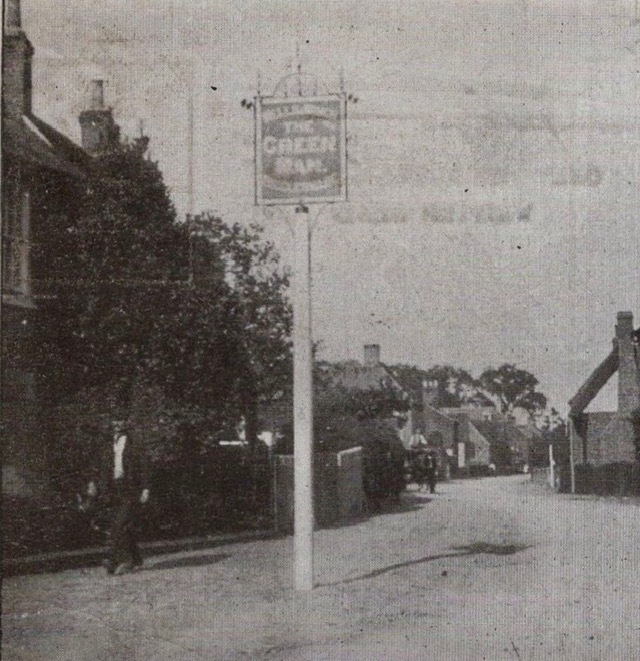
Date of photo: 1904 |
Picture source: Hania Franek |
|
|